← Notes Toward a Theory of Attention
Chapter 3 · 3
What Follows
If attention is conserved and its returns diminish, a few practical consequences follow that are worth stating outright.
The first is about information, not attention itself. A wealth of information creates a poverty of attention (Simon, 1971): every new feed, notification, and tab is a claim on a fixed budget, and the claims now vastly outnumber what the budget can honour. Figure 1 shows the shape of the problem — the supply line is flat while the demand for it climbs without limit.
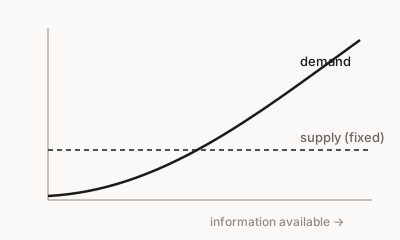
The second consequence is about design. Table 1 gathers a few interventions and what each one does to the budget. Note that they are not equivalent: some add supply at the margin, others simply reduce the number of claims.
| Intervention | Acts on | Effect |
|---|---|---|
| Batching alike work | The price | Fewer costly context switches |
| Removing a feed | The demand | One fewer standing claim on the budget |
| A single daily plan | The allocation | Equalises marginal return across tasks |
The third consequence is personal, and the model from the previous chapter already implies it: because the optimum is neither monomania nor scatter, a good day is one that holds a small number of tasks at the point where their marginal returns are roughly equal — and then, crucially, defends that arrangement against the day's standing tide of claims.
None of this is a productivity system. It is closer to a constraint: spend the one budget you cannot grow as though you could not grow it.